
Gender and Climate: What Findings? What Challenges?
As part of the Feminist Integration Weekend held on September 2–3, 2023, by the Egaé group, the Student Observatory on Sexist and Sexual Violence in Higher Education, Consentis, En Avant toute(s), HandsAway, and Stop Fisha, the RAJA-Danièle Marcovici Foundation organized a roundtable discussion exploring the role of women in the fight against global warming and the protection of the environment.
12 September 2023
This event took place in a political and social context marked by growing awareness of the intersection between gender and climate issues.
According to the study Progress on the Sustainable Development Goals: The Gender Snapshot 2023, published by UN Women and the United Nations Department of Economic and Social Affairs (UNDESA), over 340 million women and girls – approximately 8% of the global female population – are at risk of living in extreme poverty by 2030. Similarly, the World Health Organization (WHO) and UNICEF have warned that women are disproportionately affected by climate change and suffer greater impacts than men.
Findings from the Intergovernmental Panel on Climate Change (IPCC) also reveal that women are 14 times more likely to die in climate-related disasters than men. Women make up 70% of the world’s poorest populations, and 44 million women were forced to flee their homes in 2021 as a result of climate change and human rights violations.
For these reasons, it is essential that women play a greater role in transition processes and have better access to leadership and decision-making positions.
The discussion was moderated by Sophie Pouget, Executive Director of the RAJA-Danièle Marcovici Foundation, alongside Alice Apostoly, Co-Director of the Institute for Gender in Geopolitics; Aminata Niakate, Adviser to the Economic, Social and Environmental Council (ESEC) and rapporteur of the report Gender Inequalities, the Climate Crisis and the Ecological Transition; and Fanny Petitbon, Advocacy Director at CARE France.
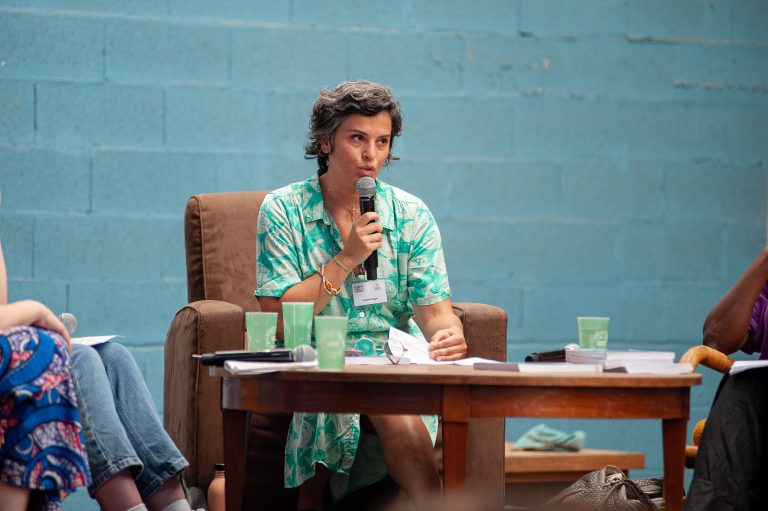
© Olivier STAUB
Alice Apostoly shared her analysis of the global agenda on integrating gender perspectives into climate action and reflected on the level of attention given to this issue by major international and national institutions. She also highlighted the importance of youth involvement and visibility in international negotiations.
Fanny Petitbon offered insights drawn from CARE France’s field experiences on gender and climate within local projects, illustrating how these dimensions are integrated into practical community actions. She also provided a critical overview of the French government’s commitments to mainstreaming gender in its climate policies.
Referring to the CESE report mentioned above, Aminata Niakate detailed key recommendations, particularly at the international level, to ensure stronger gender integration in climate action. She also identified key levers for advocating these recommendations before international bodies and at the forthcoming Conference of the Parties (COP28).